Ludwig Wittgenstein: Believe You Are Pretending
PREFACE
Wittgenstein begins Philosophical Investigation with an extract of Augustine’s Confessions:
Cum ipsi (majores homines) appellabant rem aliquam, et cum secundum earn vocem corpus ad aliquid movebant, videbam, et tenebam hoc ab eis vocari rem illam, quod sonabant, cum earn vellent ostendere. Hoc autem eos veile ex motu corporis aperiebatur: tamquam verbis naturalibus omnium gentium, quae fiunt vultu et nutu oculorum, ceterorumque membrorum actu, et sonitu vocis indicante affectionem animi in petendis, habendis, rejiciendis, fugiendisve rebus. Ita verba in variis sententiis locis suis posita, et crebro audita, quarum rerum signa essent, paulatim colligebam, measque jam voluntates, edomito in eis signis ore, per haec enuntiabam." (Augustine, Confessions, I. 8.)
Translation:"When they (my elders) named some object, and accordingly moved towards something, I saw this and I grasped that the thing was called by the sound they uttered when they meant to point it out. Their intention was shewn by their bodily movements, as it were the natural language of all peoples: the expression of the face, the play of the eyes, the movement of other parts of the body, and the tone of voice which expresses our state of mind in seeking, having, rejecting, or avoiding something. Thus, as I heard words repeatedly used in their proper places in various sentences, I gradually learnt to understand what objects they signified; and after I had trained my mouth to form these signs, I used them to express my own desires.”
LANGUAGE GAMES
Ludwig Wittgenstein latest and most influential work, Philosophical Investigation of 1953, begins with this extract of Augustine’s Confessions, which makes a detailed account of an observation by a young person toward his elders carrying out what seems to be a rather mundane, everyday activity.
But the elders are, Wittgenstein argues, participating in what he calls “games”. These games are elementary human activities of life — for example picking up an object, uttering a sound (a word), pointing toward the object, conduction certain bodily movements in relation to the object, engaging in mimicry, and performing other human behaviors.
Wittgensstein says Augustine’s description gives us an example of one of those models that collectively form the scaffold of all human language — the universe of which is what he calls “language games”.
Wittgenstein understands Augustine’s above account as a representation of language games in practice:
“These words, it seems to me, give us a particular picture of the essence of human language. It is this: the individual words in language name objects — sentences are combinations of such names. In this picture of language we find the roots of the following idea: Every word has a meaning. This meaning is correlated with the word. It is the object for which the word stands.”
Wittgenstein says language games describe how language operates within a preset matrix of human activity. And that matrix is the simultaneous realisation of the following key concepts:
(1) Words and sentences
(2) Rules governing language (grammar and logic)
(3) Social activity (the context in which the language appears)
To clarify, these games can be observed in everything from mundane, everyday activities to high-level philosophical chain-argumentation. It’s everything from greeting a friend, giving a command, telling a joke, or defending a political standpoint.
DECIPHERMENT OF INTENT
It all comes down to the concept of “intent” or “meaning”. It’s about on one side finding meaning in language, and on the other expressing new meaning via language.
The essence is that meaning can only be contrived, or produced, so long as the words fit into the system of the language game. In Augustine’s example above, the entire conceptualization of any meaningful human activity falls apart if the elder for example pointed toward an apple, then uttered “sky”. The point is that the game demands adherence to embedded human activity rules, for example that when one points toward an apple, only certain synchronic actions will bestow.
Wittgenstein describes language at its most foundational level as such:
That philosophical concept of meaning has its place in a primitive idea of the way language functions. But one can also say that it is the idea of a language more primitive than ours. Let us imagine a language for which the description given by Augustine is right.
The language is meant to serve for communication between a builder A and an assistant B. — A is building with building- stones: there are blocks, pillars, slabs and beams. B has to pass the stones, and that in the order in which A needs them. For this purpose they use a language consisting of the words "block", "pillar", "slab", "beam". A calls them out; B brings the stone which he has learnt to bring at such-and-such a call.
— Conceive this as a complete primitive language.
Wittgenstein exemplifies further by asking the reader to extract meaning from the following symbol:
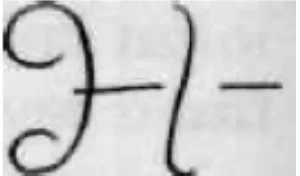
One may assume it could be a letter of a foreign alphabet, simply an errornous one, a child’s sketch, or one like the “flourishes" of a legal document. Wittgenstein says: “I can see it in various aspects according to the fiction I surround it with.“, and that is the point in a nutshell — symbols change depending on the context in which they appear.
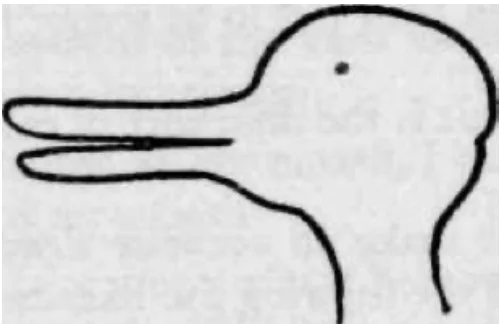
He also uses Jastrow’s famous duck-rabbit as an example of this; meaning is derived from the synchronization of symbol and context — not the symbol alone.
ON TRUTH AND LIES
Wittgenstein discusses the nature of the “lie” — as an opposition to the “truth” — and establishes that while one can establish a certain “imponderable” evidence of truthfulness toward a statement, such evidence is always “subtle”, and not trustworthy.
“Ask yourself: How does a man learn to get a 'nose' for something?And how can this nose be used?”
(p. 229)
Wittgenstein then closes with this humorous description of the obscure nature of conceptualising truthfulness and lie:
“There might actually occur a case where we should say:
‘This man believes he is pretending.’”
❧
Wittgenstein, Ludwig. PHILOSOPHICAL INVESTIGATIONS (G. E. M. ANSCOMBE). 1953